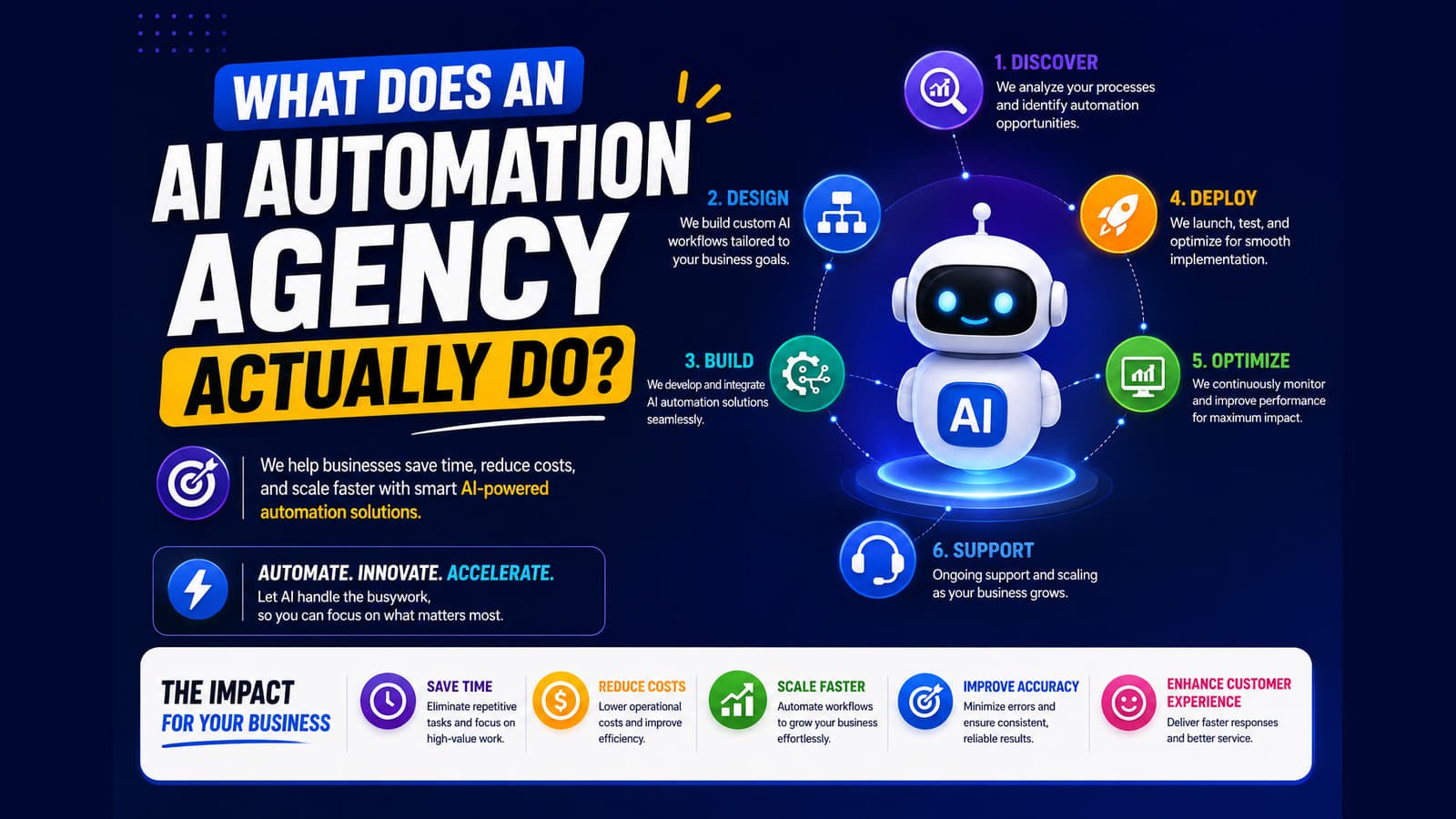
An AI automation agency identifies the repetitive, rule-based work inside a business, builds systems that run it without a person, connects those systems to the tools the business already uses, and maintains them afterwards. That is the whole job. The phrase sounds vaguer than it is, mostly because the industry describes itself in capability rather than in work, so here is the work.
1. Discover — finding what is worth automating
The first phase is not technical. It is an operational review that maps how your business actually runs and scores each process on three things: how often it happens, how consistent the steps are, and what it costs you in time or errors.
Processes that are high volume, low variability and high value are worth automating. Most processes are not, and a significant part of this phase is producing that list too. An agency that finds everything automatable has not done the work — it has done a survey.
This phase also produces the baseline: how many hours the process consumes now, how often it fails, how long it takes end to end. Without that number captured before anything changes, nobody can prove later that the work paid off.
2. Design — deciding how it should work
Once the target is chosen, the design phase decides the logic: what triggers the process, what decisions get made automatically, what needs a human to approve, and what happens when something unexpected arrives.
That last one is where most of the real design effort goes. The happy path is easy. The value is in deciding what the system does with the invoice in the wrong format, the lead with no phone number, the customer who replies with something nobody anticipated. A design that only handles the expected case fails in week two.
This is the kind of system we build as an AI automation agency for US businesses — scoped to the process, not sold as a seat licence.
3. Build — connecting it to what you already run
The build connects your existing systems — CRM, inbox, calendar, billing, whatever you already use — and puts the automation between them. Modern automation is mostly integration work plus decision logic, not writing software from scratch.
The agency handles authentication, data mapping between systems that name the same field differently, error handling and retries, and the AI components where judgement is genuinely needed — classifying a message, extracting fields from a document, drafting a reply for review.
A note on scope: a good agency builds around your stack rather than replacing it. Proposals that begin with migrating you to a new platform are sometimes correct and are more often a bigger project than the problem required.
4. Deploy — going live without breaking anything
Deployment is rarely a single switch. The usual pattern is to run the automation alongside the existing manual process for a period, compare the outputs, and only then hand it the work.
This phase also includes the part that determines whether the system gets used: training the people whose jobs it changes. An automation nobody trusts gets worked around, and a worked-around automation is worse than none, because you are now paying for it and still doing the task.
5. Optimise — watching it and improving it
Once live, the system needs monitoring, and this is the phase most often left out of cheap engagements. A broken manual process is obvious because a person is standing in front of it. A broken automated process is silent — leads stop routing, invoices stop matching, and everything looks normal until someone asks why the numbers moved.
Optimisation also means tuning against the baseline captured in phase one. Is it actually saving the hours it was supposed to? Where is it still escalating to a human, and can that case be handled now that there is real data on it?
6. Support — keeping it working as things change
An automation is not a finished object. Models change, APIs get deprecated, your process evolves, and a system left untouched for a year will have quietly degraded. Ongoing support covers monitoring, fixing what breaks, and adjusting the logic as the business changes.
This is the phase to price explicitly before the build rather than after. A retainer described only as support is unpriced — ask how many hours, what response time, and what counts as new work rather than maintenance.
What actually gets built
In practice the work clusters into a handful of recognisable systems.
- Lead handling — capture, enrichment, scoring, routing and instant first response.
- Voice agents that answer calls, qualify, and book into a calendar.
- Document and inbox processing — extracting fields, classifying, drafting replies for approval.
- CRM hygiene — deduplication, stage progression, follow-up sequences that fire on real behaviour.
- Internal reporting that assembles itself rather than being rebuilt each month.
- Handoffs between systems that a person currently performs by copying and pasting.
What an agency should not be doing
Three things are worth naming because they are common and they are not the job.
It should not be automating a process nobody owns — automation applied to an undecided process just makes the confusion faster. It should not be quoting before it has looked at your systems, because that number will be revised. And it should not be building in accounts you cannot access, however convenient that is during the build.
The simplest summary of the whole role: an agency is there to work out which of your problems are worth solving with software, build the ones that are, and tell you plainly about the ones that are not.
That is what the work involves. For the other half of the question, what this work costs sets out the real ranges by pricing model.
Key takeaways
- The work is six phases: discover, design, build, deploy, optimise, support — and the first is operational, not technical.
- Discovery should produce a list of what not to automate as well as what to automate.
- Most of the design effort goes into the unexpected cases, not the happy path.
- Modern automation is mostly integration and decision logic rather than writing software from scratch.
- Monitoring matters more here than in most software, because automated failures are silent.
Related services
AI Workflow Automation
We architect and build intelligent workflow systems that connect your tools, execute decisions, and run processes around the clock — without any human input.
Explore automation infrastructureCRM Automation
We turn your CRM into an intelligent revenue engine — automated pipelines, smart follow-ups, AI scoring, and reporting that shows what to do next.
Explore crm intelligence